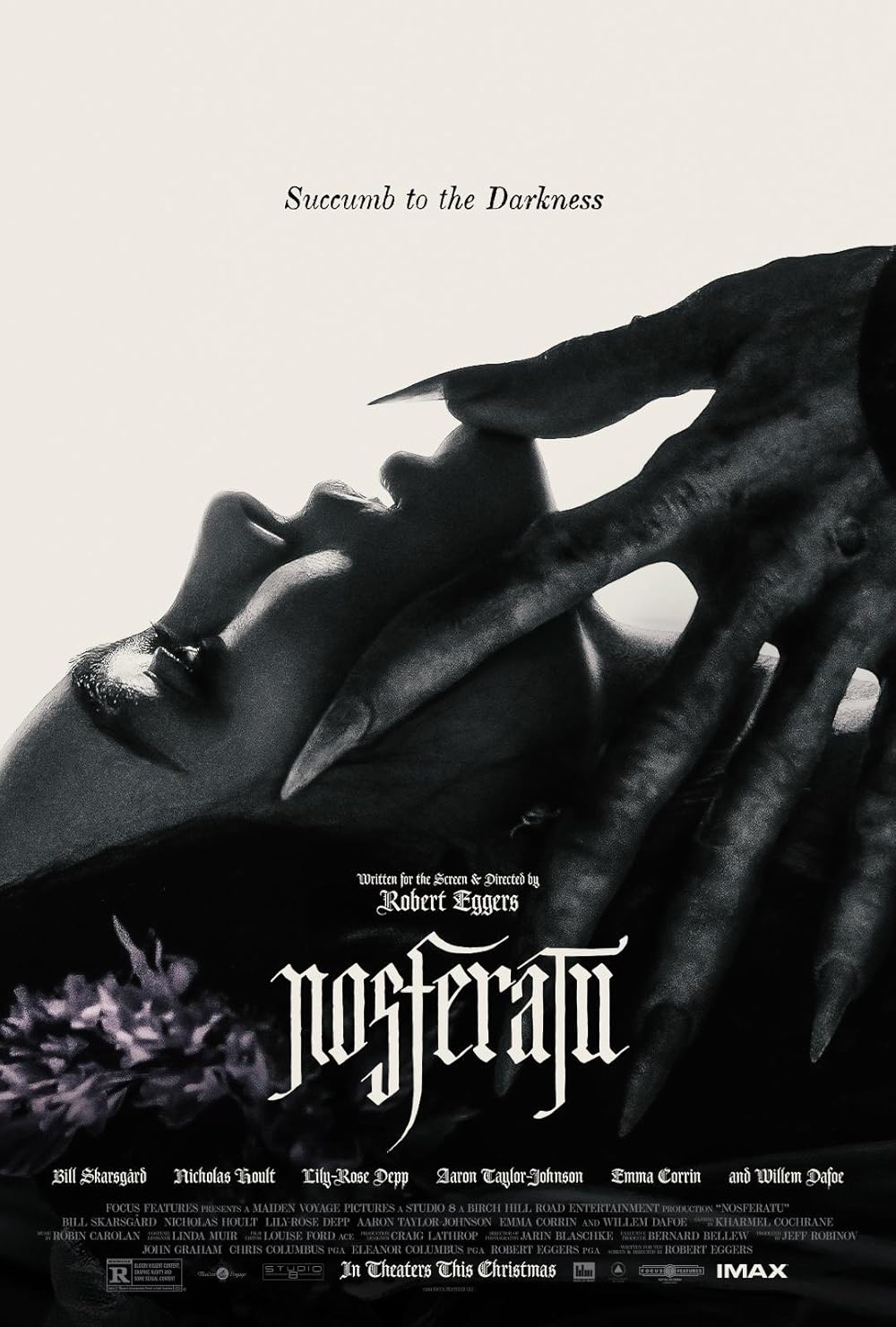
Oh, what to make of Robert Eggers’ Nosferatu? Why did it leave me so conflicted?
The horror auteur’s gritty and grim realism is married to a gothic formalism which allows for the folkloric aspects of the vampire legend along with the psychosexual subtext to come through even stronger than in previous incarnations featuring Count Orlok or Dracula. The set designs, lighting, costumes, cinematography and music are mesmerizing and pull the viewer into the dreadful milieu and creeping horror. Eggers calls back frequently to the two previous films of this name where the shadows, angles, and fingernails of Murnau are used to sometimes even greater effect here, while the “vampirism as a plague brought by rats” of Herzog doesn’t work quite as well in spite of layered Covid allusions in the script.
Speaking of the script, it’s slightly off-kilter nature enables tension to be built and released. Witness any of Willem Dafoe’s lines (he is a delight as the Van Helsing stand-in) or Emma Corrin’s pleading with the near-hysterical and melancholy Lily-Rose Depp during a walk on the shore, “It’s Christmastime, why do you insist on being so contrary?” Eggers’ scene transitions between absurdist horrors and dead-serious line readings that would otherwise be silly add just enough dark humor to the proceedings.
But then there is Lily-Rose Depp, portraying the monster’s obsessed/possessed paramour, who at one point goes full exorcist. There were times her earnest yet over-the-top performance seemed apt, but other times it was just…off. I agreed with Corrin…why did she have to be so contrary?
And then there’s Nosferatu himself. Eggers has created the most grotesque version of the monster imaginable…but then why the mustache? It almost came across as a joke, though more likely a nod to Vlad the Impaler, famously mustachioed. And the un-asked-for nudity. Again…it verged on camp and seemed to run contrary to the otherwise brilliantly done make-up and effects meant to horrify.
There were distractions like this throughout the film, along with illogical passages of time (some characters die graphically one night only to be theatrically buried in all the official fineries, during a raging pandemic no less, the very next day) that prevent me from hailing this as an instant classic like its predecessors.
But is this still the best traditional vampire flick since Coppola’s wild Bram Stoker’s Dracula from over thirty years ago? Probably. Like that film, this one is both formalized in the language of horror films while also being its own unique brand of brazenly untamed. But I still can’t help but wonder, what was the point of it all?
 The Schleicher Spin
Absolutely right, what is the point ? I’m still wondering. Does Eggers himself know the answer ? Not sure.