
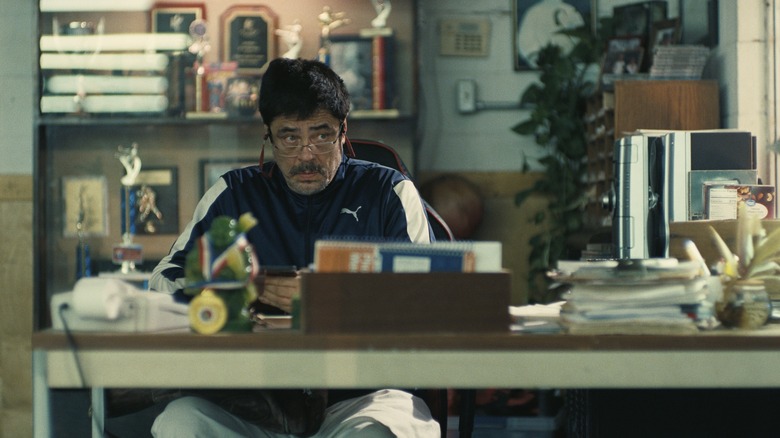
There’s something comforting in watching a sprawling film from a seasoned auteur in late middle age. PT Anderson doesn’t need to show off or be flashy anymore – although he apparently expended an enormous budget here – and can just do his thing. The smart song choices, the framing of scenes, the pacing, the cinematography, it’s all exactly what you would expect from him. As usual, he lets the cast do their thing, too. And we as viewers, familiars, can let him take us on a journey. I was honestly a little reluctant to go on this one. The marketing was all over the place, his last Thomas Pynchon inspired film was my least favorite film from him, and the run-time for this is as bloated as the budget. But I quickly realized the level Anderson was operating on and went on the journey that ended with me entertained and satisfied.
One Battle After Another is first and foremost genre-defying. It doesn’t fit into any bucket, and more so than any PT Anderson film before it’s hard to define. In his early days he channeled Scorsese (Boogie Nights) or Altman (Magnolia) to reach dramatic highs before finding his own unique voice. Initially I felt like he might be riffing on his contemporary Tarantino here, but the journey quickly proved to be purely Andersonian. Layered with the political commentary, the satire, the absurdism, the action, and the dark humor is the very personal theme of fathers and daughters, and specifically here, much like Anderson in real-life, a white father and mixed daughter. Earlier in his career Anderson seemed to be gazing back at father and son melodrama – perhaps echoing his own with his father? – but now in his late middle age he seems to be looking forward. What world will be left for his daughters, for our children? What battles will they have to carry on?
Another evolution here is Anderson’s mastering of the more traditional sense of cinematic suspense. Before his films were usually anchored in psychological tension and the threat of emotional outbursts, and while There Will Be Blood hinted at some untapped talent for traditional suspense, One Battle After Another is expertly riddled with it. The threat of violence or being caught is omnipresent in this tale of the two fringes of American political ideologies warring with each other. And that climactic car chase across the barren California desert highway that buckled like a rollercoaster is a masterpiece. Along the way Jonny Greenwood’s score creates a discordant symphony feeding off the tension of the everyday alarms always beeping in the background of our un-silent anxiety-soaked lives. And Anderson makes everything a battle where even the mundane annoyance of forgetting a password to get help over the phone rises to the level of an epic struggle.
Did I mention the cast was great? Sean Penn as a prurient-minded white supremacist longing to join the absurdly named Christmas Adventurers Club (Hail Saint Nick!) is getting most of the buzz. But the character and performance I found most engaging was Benicio Del Toro as the helper of all lost and in-transit souls, Sensei Sergio St. Carlos. His calm amongst the many storms, the endless everydayness of his activities, be it running an underground railroad for immigrants, teaching karate, helping a former revolutionary (Leonardo DiCaprio) find his kidnapped daughter (Chase Infiniti), or getting pulled over for drunk driving, is a knowing nod to there being no current human struggle that is new under the sun. It always has been and always will be one battle after another, and the Sensei’s choice to go with the flow of chaos and still hold onto his moral compass is a righteous path indeed.
 The Schleicher Spin