Sing me a song, oh muse, of the wonders of Christopher Nolan’s cinematic vision of Homer’s The Odyssey.
At this point in his storied career, audiences know exactly what to expect from Nolan’s patented brand of film spectacle. It’s why we keep returning again and again based on his name alone. It’s always fascinating that no matter what type of story he chooses to tell – be it a psychological mind-bender, comic book thriller, sci-fi odyssey, historical drama, or a three-thousand-year-old epic Greek poem – he’s going to put his stamp on it. The Odyssey features many of his recurrent themes: fathers trying to find their way home, the pain and yearning that accompanies the passage of time, women scorned, and noir inspired drama in the form of palatial double-crossings and revenge plots. He even works in a small twist at the end to explain the source of Odysseus’s visions of Athena (Zendaya).
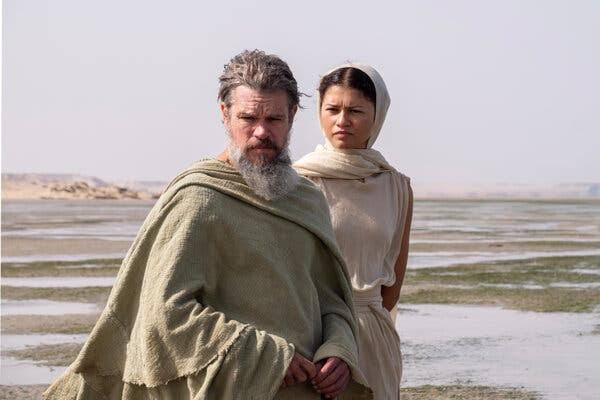
Central to the film is the clever weaving of the backstory detailing the sacking of Troy from both the point-of-view of Telemachus (Tom Holland) hearing stories of his father’s triumphs and the point-of-view of Odysseus (Matt Damon, in probably the best performance of his career) trying to remember his tortured past while on Calypso’s island (where Charlize Theron haunts the beach like a goddess about to launch a new line of lotus flower inspired perfume). Nolan enters the well-known story by composing a very deliberate visual centered on the legendary Trojan horse being dragged to the city gates not upright on wheeled carts but sideways through the sand by ropes. It’s symbolic of how Nolan is about to turn the well-worn mythic tropes on their heads.
With The Odyssey, Nolan also delivers things we don’t expect. The monstrous horrors of certain episodes in our hero’s journey are built with practical effects – puppets, models, and make-up – adding a layer of eerie realism to the most fantastical elements of the story. The screams and cries of the cyclops are like otherworldly sounds we’ve never heard before. Sound always plays a crucial and immersive role in Nolan’s storytelling, often overly loud and chaotic in scenes of escalating suspense. Later, Nolan shows us how the absence of sound can be equally as immersive when he shows us the legendary sirens through the eyes of the soldiers who have blocked their ears while Odysseus alone – silently wailing in abject torture while tied to the ship’s mast – hears their haunting song. Later, in one of the more surprisingly quiet and heartfelt scenes of mostly dialogue, Odysseus (disguised as a beggar) and his long-suffering wife Penelope (Anne Hathaway, luminously emotive and Oscar-worthy) act out a reunion scene that seems inspired by interludes from Paris, Texas.
Through the film, Nolan’s cavalcade of stars in minor roles show up for their respective scenes and limited screen time acting as if these are the last roles they’ll ever play. Samantha Morton as Circe is particularly effective and nightmarishly memorable, but so is Lupita Nyong’o in dual roles played to the theatrical max. There are no small parts or small actors in The Odyssey, and the creative casting works brilliantly, especially in the arch of Elliot Page’s character whose emotional request from Hades leads Odysseus to deliver once of the best villain comeuppances Nolan has ever conjured.
The technical elements of the film astound with Ludwig Goransson’s non-orchestral score providing organic thrills in the tensest of scenes and Hoyte van Hoytema’s visual compositions creating awestruck moments in IMAX or any format.
So, dear reader, does The Odyssey deliver? I haven’t even touched on the timely subtext around societal collapse and forgetting the mistakes of the past, which is there if you want it, and barely there if you don’t. You could write another epic poem about the wonderous depths of this adaptation. Simply put Nolan has once again upped his own game and delivered on his brand promises to surprise, thrill, and delight his loyal audience. I’d never turn down an opportunity to go on one of his cinematic odysseys.


What a wonderful review ! I especially love the textile metaphor you use to signify the weaving together of stories in the Odyssey. Nolan (like Tarantino in a completely different style) really shows his expertise here. And you rightly connect him to the sensitivity of a Wenders, which now really jumps out at me. Homer’s songs, like those of the sirens, definitely haven’t finished enchanting us.
I can’t get over that screen (the details and design of it) that Penelope stayed behind. And then when the disguised Odysseus spoke to her through the screen and confessed all his pain and love, just like Harry Dean Stanton did to Nastassja Kinksi from the other side of the peep-show window in Paris, Texas…I just wasn’t expecting that level from Nolan. Absolutely wonderful stuff.
Nolan is a director who just doesn’t miss. He has never made a “bad” film in my mind.
After sitting with it for a few days, The Odyssey is emerging as one of his best. Only time and repeat viewings will tell, but it’s circling the Top Three for me.
Here would be my rankings for Nolan’s films. Feel free to share your own in the comments.
I’m still reeling from this experience. Nolan delivers once again, dialing it up to 11 in all the best ways. And Matt Damon! I was just reflecting on how Good Will Hunting is nearly 30 years old now, and he has really come a long way as an actor since then. The whole cast is great, but Damon is on another level in this. The sound design and score are so good they’re almost characters unto themselves. I’m really looking forward to watching this again.
I honestly didn’t think Damon would work in this role, but he killed it. The sound and music definitely were characters – and as many have pointed out, at times they may have been representations of the Greek gods.